Residential Real Estate in Portugal – End-of-2025 Market Overview and 2026 Forecast
The Portuguese residential property market has heated up significantly in recent years. Property prices reached record levels in 2025, driven by exceptionally strong demand and limited supply. For affluent international investors, Portugal remains an attractive destination, offering stability, a favourable climate and still lower prices than many Western European countries (Properstar, 2018). This article summarises the current situation in Portugal’s residential property market at the end of 2025 and presents an outlook for 2026. We focus on the key regions (Lisbon, Porto, Algarve), analyse demand trends, including foreign investors, expatriates and digital nomads, discuss regulatory changes such as Golden Visas and short-term rentals, and examine the supply constraints contributing to rising prices. All of this is presented in an accessible, expert tone, from the perspective of an experienced real estate advisor with in-depth knowledge of the market.
Residential property market situation at the end of 2025
2025 brought further dynamic growth in residential property prices in Portugal, continuing the trend observed in previous years. According to data from the Portuguese National Statistics Institute (INE), in April 2025 the median bank valuation of residential property reached €1,866 per m², representing an impressive increase of approximately 16.9% year on year (Global Property Guide, 2022). This marked the seventh consecutive month of double-digit annual price growth, beginning in late 2024. Such strong momentum places Portugal among the fastest-growing property markets in the European Union (Investropa, 2025).
The main driver of price growth is the imbalance between supply and demand. Demand, particularly from international buyers, remains strong, while the supply of new housing is increasing too slowly to meet market needs (Global Property Guide, 2022). Low mortgage interest rates in previous years, despite rate increases in 2022–2023, together with expectations of future cuts, continue to support buyer interest. Experts also point out that developers’ focus on the premium segment, with more expensive projects aimed at affluent international buyers, is contributing to higher average transaction prices.
As a result, average asking prices for residential property in Portugal reached record levels by mid-2025. According to Idealista, the nationwide median asking price in May 2025 was approximately €2,851 per m² – 7.4% higher than a year earlier (Investropa, 2025). By comparison, according to bank valuations, which tend to be somewhat more conservative, the average transaction price in the second quarter of 2025 was closer to €1,965 per m² (KRN, 2025). This difference suggests that sellers have high price expectations, although these are not always fully reflected in completed transactions.
Property prices in Portugal’s key regions
Portugal’s residential property market varies significantly by region. The most expensive areas remain the major cities and coastal regions, particularly the Lisbon metropolitan area and the Algarve, while prices in inland areas and smaller towns are noticeably lower. Below, we examine three key locations from the perspective of international investors: Lisbon, Porto and Algarve.
Lisbon is Portugal’s most expensive property market and a major magnet for international investors. At the end of 2025, median asking prices in the city of Lisbon are estimated at around €5,700–6,000 per m² (Global Property Guide, 2022), while prices in the most desirable districts frequently exceed €8,000 per m². Idealista data from early 2025 indicated an average asking price in Lisbon of approximately €6,424 per m², including new properties, renovated homes and properties requiring refurbishment (TAGUS PROPERTY, 2025). In central, prestigious districts such as Santo António, Chiado and Príncipe Real, new luxury apartments reached as much as €10,000–12,000 per m². By comparison, across the wider Lisbon metropolitan area, including more affordable suburbs, the average apartment price in 2024 was approximately €3,644 per m² (Properstar, 2018), highlighting the substantial premium paid for central locations in the capital.
Price trend: Indicators such as median bank valuations continued to show double-digit property value growth across the Lisbon metropolitan area, reaching approximately +19.8% year on year for apartments in Greater Lisbon in spring 2025. The capital’s market remains highly constrained, as reflected by the fact that almost 40% of all residential property spending in Portugal, measured by transaction value, is concentrated in Lisbon and the surrounding area (Calicchio, 2025).
Porto, the country’s second-largest city, offers somewhat more affordable property prices than Lisbon while also recording strong value growth. Average apartment prices in Porto are currently estimated at around €3,500–4,000 per m² in the city’s most desirable districts, while the average across the wider Porto metropolitan area is approximately €2,200 per m².
Price trend: In 2025, Porto demonstrated a strong upward trend, with estimates suggesting that property prices in Porto and the surrounding area increased by as much as 8% year on year (Investropa, 2025). InvestRopa reports that asking prices in Porto’s central districts alone may have risen by between 5.8% and 8.6% year on year. This is higher than in Lisbon and suggests that Porto is gradually closing the price gap. The city is becoming increasingly recognised internationally, driven in part by tourism and foreign investment, while still remaining relatively more affordable. For investors, this may translate into greater potential for capital appreciation in the coming years.
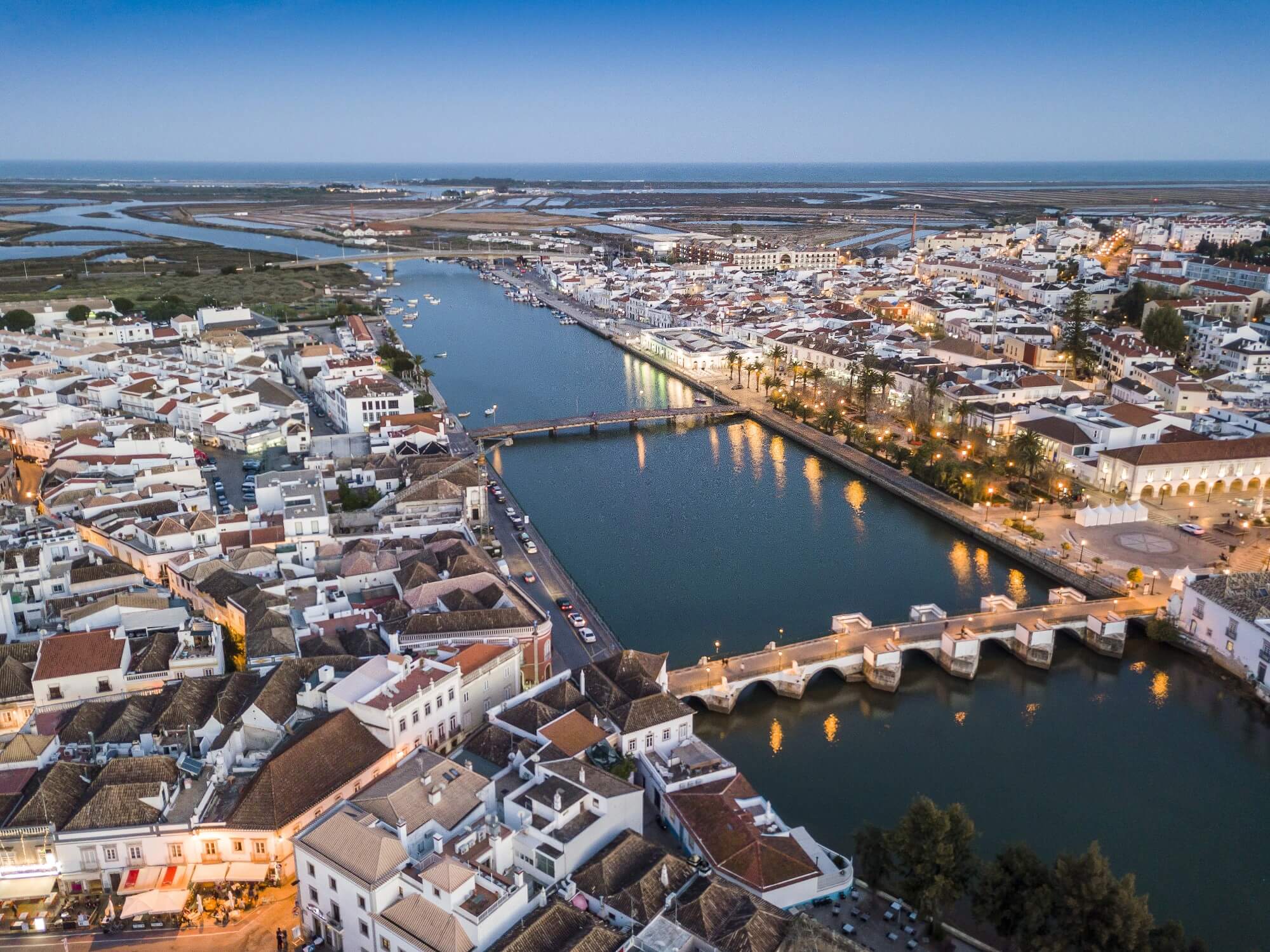
The Algarve, Portugal’s sunny southern region, has long attracted international buyers – from those looking for a holiday or retirement home to investors focused on the short-term rental market. Property prices vary significantly across the region. On average, apartments in the Algarve are priced at around €3,300–4,300 per m² (Calicchio, 2025), while values in the most prestigious locations are considerably higher. The so-called “Golden Triangle” – Quinta do Lago, Vale do Lobo and Vilamoura – is among the most expensive areas in the country, with average prices exceeding €8,000 per m² and luxury villas in Quinta do Lago reaching as much as €10,000–12,000 per m² (TAGUS PROPERTY, 2025). In popular coastal destinations such as Lagos, Loulé and Albufeira, prices typically range between €5,000 and €6,000 per m², while less crowded towns such as Portimão, Tavira and inland São Brás de Alportel offer properties in the €3,000–4,000 per m² range.
Price trend: In 2025, the Algarve was one of Portugal’s fastest-appreciating property markets. Annual price growth across the region is estimated at approximately 18.5%, making the Algarve one of the strongest-performing regions in mainland Portugal (Investropa, 2025). This growth has been driven in part by sustained international demand for holiday homes, combined with geographically and regulatory constrained supply along the protected coastline. Local authorities also seek to preserve the region’s character by controlling development density in coastal areas. From an investment perspective, these restrictions may help support long-term property values by limiting overdevelopment and maintaining the exclusivity of prime locations.
Foreign buyers play a major role in the Portuguese residential property market. Despite changes to government programmes, which we discuss below, international interest in Portuguese real estate remains high and continues to grow. In 2024, foreign buyers accounted for approximately 12% of all property purchasers in the country by number of transactions, while their share grew by an average of around 8% per year between 2019 and 2024 (Calicchio, 2025). Their share in terms of transaction value is even higher, as international investors typically purchase more expensive properties than local buyers. The average purchase value for a non-EU buyer is approximately €405,000, compared with around €277,000 for the average EU citizen. This means that, in value terms, as much as approximately one quarter of the total amount invested in Portuguese residential property may come from foreign buyers.
Where do foreign investors come from? Traditionally, European nationalities such as the British, French and Germans have dominated the market, alongside buyers from China and Brazil. In recent years, however, there has been a significant shift: Americans have moved into the leading position in Lisbon, becoming the largest group of foreign buyers in the city over the past two years. Investors from the United States are attracted by the climate, safety and relatively affordable prices from their perspective. According to Tagus Property, in both 2022 and 2023 US citizens accounted for the highest number of property purchases by foreign nationals in Lisbon, overtaking the former leaders – the French. Chinese and British buyers followed. This reflects a broader trend: many Americans, particularly affluent remote workers and retirees, have discovered Portugal as an attractive place to live, a phenomenon sometimes associated with the post-pandemic “Zoom boom”.
Digital nomads and remote workers represent another growing source of demand. In 2022, the Portuguese authorities introduced a dedicated digital nomad visa (D8), allowing people working remotely for foreign companies to settle in Portugal without having to pay local tax on foreign income (Rua & Demony, 2023). This policy attracted a wave of highly qualified professionals, particularly from the technology sector and other knowledge-based industries, who often rent premium apartments in city centres or purchase smaller properties of their own. Lisbon and Porto have increasingly been mentioned alongside cities such as Barcelona and Berlin as hubs for remote workers. This has further increased demand in the rental market, pushing rents higher, while also indirectly supporting the sales market, as some digital nomads eventually decide to settle in Portugal permanently.
Effects of foreign demand: The strong presence of international buyers contributes to higher prices. According to research, foreign purchasers pay on average 82% more for property than local buyers (Holder, 2025). Although this may not be a concern for international investors, it is worth being aware that both government policy and public sentiment are increasingly focused on this issue, particularly as concerns grow around housing affordability for local residents. In the following section, we examine how these pressures have influenced regulation, including the termination of the property-based Golden Visa programme and restrictions on Airbnb.
Legal and regulatory environment: Golden Visas and short-term rentals
In recent years, the Portuguese government has introduced significant legal changes that indirectly affect the residential property market and the decisions of foreign investors. From an investor’s perspective, the most important changes include:
End of the property-based Golden Visa programme: As part of efforts to address the housing crisis, the government announced in 2023 the end of the controversial Golden Visa programme for new real estate investments (Business Insider, 2023). Since 2012, the programme had allowed non-EU citizens to obtain residency rights, and ultimately citizenship, in exchange for investment, primarily through the purchase of property worth at least €500,000. The scheme attracted more than €6.8 billion in capital, largely into the real estate market, but was criticised for contributing to rising prices and limiting housing affordability for local residents. The government of Prime Minister António Costa decided to phase it out, and since the end of 2023, purchasing property in Portugal no longer qualifies an investor for a Golden Visa.
Short-term rental regulations (Airbnb): Alongside the termination of the Golden Visa programme, the government introduced restrictions in 2023 on issuing new licences for short-term tourist accommodation, including Airbnb properties, in the largest cities and popular tourist destinations (Business Insider, 2023). New permits for Alojamento Local (AL), as this form of accommodation is known, were suspended in areas experiencing significant housing pressure. Exceptions apply to sparsely populated areas, mainly in rural parts of the country. Existing AL licences were retained, while the government introduced tax incentives for owners willing to transfer properties from the tourist rental market to long-term residential rental. For investors focused on short-term holiday rentals, this means that entering the Airbnb market has become more difficult. In practice, operations are largely possible through properties with an existing AL licence, which has increased the value of properties sold with such licences, or in areas outside the main tourist destinations. These regulations form part of the broader “Mais Habitação” (“More Housing”) policy designed to alleviate the housing crisis affecting local residents. Lisbon in particular had a significant concentration of Airbnb properties, which also led to the introduction of local restrictions.
Tax changes for foreign residents (end of the NHR programme): In its 2024 budget, the Portuguese government decided to terminate the popular programme.
Overall, the regulatory environment has changed considerably. One positive consequence, however, is greater stability in the long-term rental market. The government is seeking to increase the supply of properties available for long-term rental through incentives and changes to tenancy legislation, while also allowing residential development on land that had previously been restricted, easing planning regulations in an effort to increase housing supply (Properstar, 2018).
Supply constraints and their impact on prices
Insufficient housing supply is one of the key factors driving property prices higher in Portugal. Despite growing demand, the country has built fewer homes than the market requires over the past decade, partly as a result of the 2008–2013 financial crisis, during which many development companies collapsed, and partly because of bureaucracy and lengthy building permit procedures. In 2025, the supply situation remained tight:
Limited new development in the mainstream segment: Most new projects target affluent buyers, particularly in the luxury and premium apartment segments, where developers see the highest margins. At the same time, there is a shortage of mid-market and affordable housing aimed at the local middle class. As a result, the supply gap in more affordable housing continues to drive price growth in the secondary market as well.
Geographical limitations: The most desirable areas – central Lisbon and Porto, as well as the Algarve coastline – are physically constrained. Lisbon has height restrictions in its historic centre, while many buildings are protected and require renovation rather than demolition and replacement with high-rise developments. The Algarve, meanwhile, has strict environmental protections that prevent unrestricted development along the coastline. These factors naturally limit the expansion of supply. In Lisbon, many new homes are created through the redevelopment of historic buildings while preserving their original façades, a process that is both costly and time-consuming (TAGUS PROPERTY, 2025). As a result, the pace of new housing delivery has failed to keep up with demand, which continues to support price growth in existing properties.
All of these factors indicate that property price growth in Portugal is supported by strong structural fundamentals. It is not purely a speculative phenomenon – prices are rising because the supply of housing remains insufficient relative to demand, particularly in the most attractive locations. As a JLL report described it, the market reflects a “combination of low supply, exceptionally strong demand and developers focusing on the high-end segment” (Global Property Guide, 2022). For long-term investors, ownership of property in a prime location may therefore provide effective capital protection, as demand continues to exceed supply and naturally supports value appreciation over time.
Outlook for 2026: opportunities and risks for investors
Looking ahead to 2026, Portugal’s residential property market continues to appear promising, although the pace of price growth may moderate compared with the exceptionally strong years of 2021–2023. The following are some of the key opportunities and risks that foreign investors considering a purchase should take into account:
Opportunities and positive trends
Continued foreign demand: Portugal is not losing its appeal – on the contrary, it continues to rank highly in quality-of-life surveys for expatriates. Even without the Golden Visa programme, there remains a strong trend of affluent foreign nationals relocating to Portugal, including buyers from the United States, Canada and Northern Europe. In addition, if monetary policy continues to ease in 2025–2026 and interest rates fall, local buyers and investors may once again become more active in the mortgage market, further strengthening domestic demand. For foreign investors, this could support liquidity when exiting an investment, as attractive properties are likely to continue drawing interest from both local and international buyers.
Economic stability and macroeconomic attractiveness: Portugal entered 2025 in relatively solid economic condition. GDP increased by approximately 1.9% in 2024, unemployment declined to around 6.5%, and public finances improved, with government debt falling below 95% of GDP. Forecasts for 2025 assumed further moderate GDP growth of around 2.3% according to the IMF. This combination of stable economic growth and improving sovereign credit ratings supports the property market by increasing investor confidence and maintaining access to financing. The absence of signs of an excessive mortgage bubble – with banks maintaining prudent lending standards, typically requiring deposits of 20–30% from domestic buyers and 30–40% from foreign purchasers – reduces the risk of a sudden collapse in demand caused by excessive leverage. In addition, Portugal’s house price-to-income ratio remains lower than in countries such as Spain or France, suggesting that despite strong price growth, the market has not reached the same level of extreme overvaluation. In other words, there may still be room for further growth before affordability becomes critically constrained.
Development of new locations and investment niches: For investors concerned that Lisbon, Porto and the Algarve have already become expensive, opportunities are emerging in other parts of the country. The Silver Coast north of Lisbon, as well as the Setúbal and Seixal areas, offer lower entry prices and may generate above-average returns as infrastructure improves and their popularity grows. Experts also point to areas of Central and Western Algarve that may still offer further growth potential. Renovation projects in city centres also remain an attractive strategy: value-add investments involving the refurbishment of older properties in Lisbon and Porto can command a significant premium upon resale.
Conclusion: Portugal’s residential property market enters 2026 with strong momentum and solid underlying fundamentals. Foreign investors can still find attractive opportunities, particularly when supported by experienced local experts and when adopting a long-term perspective. Real estate in Portugal continues to offer an attractive option for portfolio diversification, combining the potential for stable returns, relatively low political risk and lifestyle qualities that are difficult to quantify, but which continue to attract new waves of buyers from around the world.
References
Business Insider. (2023, February 17). Portugalia ma problem. Kończy ze złotymi wizami i bierze się za Airbnb. Business Insider Polska. https://businessinsider.com.pl/gospodarka/portugalia-ma-problem-konczy-ze-zlotymi-wizami-i-bierze-sie-za-airbnb/pvhjse4
Calicchio, F. (2025, May 22). Buying Property In Portugal : How To Buy, What To Know, And Tips. The Golden Portugal. https://www.thegoldenportugal.com/what-you-need-to-know-buying-a-property-in-portugal/
Global Property Guide. (2022, January 17). Investment Analysis of Portuguese Real Estate Market. Global Property Guide. https://www.globalpropertyguide.com/Europe/Portugal/Price-History
Holder, A. (2025, July 27). “There’s an arrogance to the way they move around the city”: is it time for digital nomads like me to leave Lisbon? The Guardian; The Guardian. https://www.theguardian.com/world/2025/jul/27/lisbon-portugal-digital-nomads-foreign-remote-workers-integration
Investropa. (2025, September 6). Portugal property prices: are they still rising?. Investropa. https://investropa.com/blogs/news/portugal-property-prices-still-rising
KRN. (2025, October 23). Portugalski rynek nieruchomości 2025: Rekordowe ceny, ale nadal dobry moment na zakup • KRN. Krakowski Rynek Nieruchomości • Blog, Informacje, Raporty, Newsy. https://krakowskiryneknieruchomosci.pl/portugalski-rynek-nieruchomosci-2025-rekordowe-ceny-ale-nadal-dobry-moment-na-zakup/
Properstar. (2018, September 17). Portugal House Prices in 2025: Market Trends & Costs. Properstar. https://www.properstar.ca/real-estate-guides-and-advice/portugal/house-prices
Rua, P. V., & Demony, C. (2023, February 17). Portugal ends Golden Visas, curtails Airbnb rentals to address housing crisis. Reuters. https://www.reuters.com/markets/europe/portugal-ends-golden-visas-curtails-airbnb-rentals-address-housing-crisis-2023-02-16/
TAGUS PROPERTY. (2025). Property market in Algarve: Reasons why you should buy or invest in property in the Algarve in 2025. Tagusproperty.com. https://www.tagusproperty.com/where-to-invest-property-algarve/
TAGUS PROPERTY. (2025). Lisbon property market in 2025 – Overview of real estate prices. Tagusproperty.com. https://www.tagusproperty.com/real-estate-market-lisbon/
Joanna has been involved with Partners International since 2000. In the beginning, she polished her negotiation skills while working on real estate rentals for foreigners under the watchful eye of Karolina Niedenthal – the company’s founder.
Subscribe to the newsletter
Stay updated
Our 30 years of experience, a rich offer, extensive customer base and efficiency have allowed us to enter the real estate market as a leader among real estate agencies in Warsaw, known for exceptional service and unique solutions. Join our subscription list to receive only selected content and offers from our catalog.