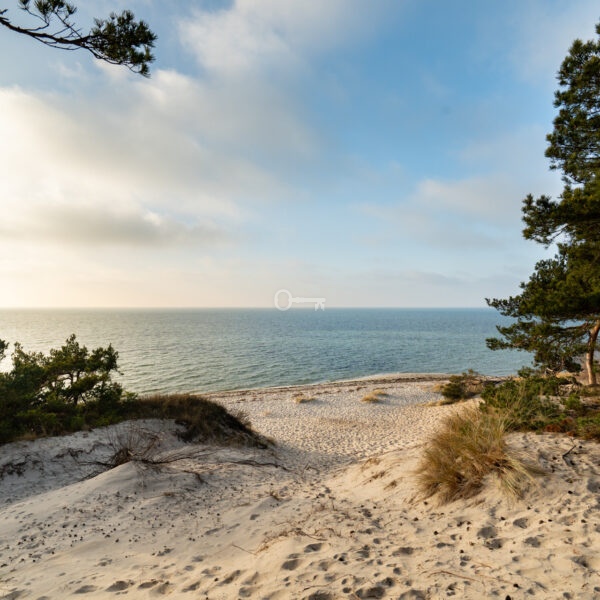
There is a place in Poland where not a single new plot for a house will ever be added. Thirty-five kilometres long, in places just one hundred metres wide, and although new developments continue to appear, each one occupies land from a pool that the law no longer allows to expand, while demand keeps growing. This is the Hel Peninsula, and it enjoys one of the mildest climates in the country: the annual temperature range in Hel is approximately 18.6°C, it has the highest number of sunny days in Poland, and the growing season lasts 200-210 days (Source: dobrypowiat.pl, aster-resort.pl, 2025-2026). This is not a place for two weeks in July. It is a place that reveals itself most fully to those who hold the keys and return here at every time of year.

What makes the Hel Peninsula truly one of a kind?
The Hel Spit is a narrow strip of land approximately 35 kilometres long, measuring just over 100 metres at its narrowest point and reaching up to three kilometres at its widest (Source: blueapart.pl, 2025). On one side lies the open Baltic Sea, with its waves, wind and dunes rising up to fifteen metres. On the other, the quiet, shallow waters of Puck Bay. Stand in the middle and two entirely different faces of the same sea are within walking distance.
This geography creates something that cannot be bought anywhere else on the Polish coast: a microclimate. The Baltic acts as a natural heat buffer, raising temperatures in autumn and winter, while cooling them in spring and summer. Hence the small fluctuations, mild winters and long, warm extension of the season into September. Add to this the pine forest that covers most of the peninsula and saturates the air with iodine. You breathe differently, sleep differently, and after three days, the body knows it.
Where does the finite supply mentioned at the beginning come from? The entire spit belongs to the Coastal Landscape Park, established in 1978, and is covered by the Natura 2000 area (Source: aster-resort.pl, forsal.pl, 2026). This protection is designed to limit new development, which means the number of places where one can actually live here does not grow. And it is precisely this that changes the way one thinks about property in this location.
A peninsula that does not force you to choose between adrenaline and silence
What is most powerful about this small fragment of Poland is that it forces no one to choose. The same thirty-five kilometres contain, at once, a windsurfing board and morning meditation, a five-year-old and his grandfather, the bustle of July and the emptiness of February. There are no separate zones for separate people. There is one life, in which all these rhythms unfold side by side.

One weekend in which everything happens
Saturday, August. In the morning, you step onto a board in Chałupy, once a village of artists and today the national capital of windsurfing and kitesurfing, where shallow, warm water and steady wind teach beginners and challenge professionals from across Europe (Source: zwiedzamy-polske.com, 2026). Beside you, your teenage daughter stands on her own board. In the afternoon, the younger child wades knee-deep a hundred metres from the shore, because Puck Bay is so shallow and calm here that there are no waves to knock them over, while Hel, on the bay side, has its “Small Beach” created for families (Source: helskimikolajek.pl, 2025). In the evening, the whole family eats fresh fish in the harbour. These are not four offers for four different people. This is one day in the life of one family.
Water that teaches, challenges and soothes
The same Baltic Sea reveals three faces here, depending on who is looking at it. For a child, it is a shallow bay in which to hoist their first sail on an Optimist racing dinghy. For an adult, it is the open, undulating side facing the full sea, demanding respect. And for the whole family, it is an attraction on a rainy day, because the Hel Seal Sanctuary, a year-round research centre of the University of Gdańsk, offers a close look at grey seals and tells the story of how their Baltic population is being restored (Source: helskimikolajek.pl, 2025). And once you have had your fill of water, the same spit offers movement and history: the EuroVelo 10 cycling route runs close to the surface of the bay, crossing the Hel Fortifications Trail with its bunkers and fire-control towers, where in September 1939 the Hel garrison held out until 2 October as one of the last outposts of the Republic of Poland (Source: pomorskie.travel, 2025).
A private sanatorium for the rest of the year
When the crowds disappear, the peninsula reveals its most precious layer. The mild microclimate extends the warm autumn well beyond September, while in winter the air contains even more iodine, an element beneficial for the thyroid, the heart and overall wellbeing, and one that cannot be found inland in the same way (Source: blueapart.pl, 2025). The paths are cleared of snow, walks along the empty beach can last for hours, and the spring migration of birds turns the sky above the bay into a moving painting, where grebes, cormorants, sandpipers and lapwings can be spotted (Source: blueapart.pl, 2025). This is not an offer for seniors. It is regeneration for anyone who spends the rest of the year in the city.

Why is the off-season climate its greatest, yet least obvious, asset?
Most people sell the Hel Peninsula through summer. Yet its true value emerges from September to May, when only a few remain. A mild winter, a long warm autumn and a growing season lasting more than 200 days mean that life here makes sense all year round, not merely for eight weeks (Source: aster-resort.pl, 2026).
This is the quality that separates the premium buyer from the tourist. The tourist arrives in July and leaves in August. The person who has a second home here drinks coffee on the terrace in November, runs along an empty beach in February and watches winter storms that can cast amber onto the shore. Throughout the year, something happens here that no holiday brochure can truly show.

Jurata, Hel, Jastarnia, Chałupy: four addresses, four ways of life
The peninsula is not uniform. Each town has its own character, and choosing between them is, in essence, choosing a way of life.
For almost a century, Jurata has been synonymous with discreet elegance, a resort of the Polish elite with the atmospheric Międzymorze promenade and a pier from which sunsets over the bay are admired. Today, it is a favourite training base for the Polish national football team, and its visitors include business leaders and artists (Source: urban.one, 2022). It is an address for those who value prestige spoken quietly. Hel, at the very tip of the peninsula, is the symbolic beginning of Poland, with its red-brick lighthouse, fishing harbour and a sense of living at the edge of the world. Jastarnia combines a marina, developed gastronomy and the year-round life of a town of around four thousand residents. Chałupy and Kuźnica, in turn, offer a relaxed surf atmosphere and the Kashubian tradition of a fishing settlement.
Within these landscapes, premium properties are now appearing that are worthy of their surroundings. Intimate estates of homes in a pine forest by a wild beach, such as Domy Rybackie by developer Hossa between Jurata and Hel. Boutique apartments by the historic lighthouse, such as Helsk Residence in Hel. Villas of just several apartments in the heart of Jurata, such as Willa Jurata. These are not mass developments. They are singular addresses, limited by the finite space of the peninsula itself.