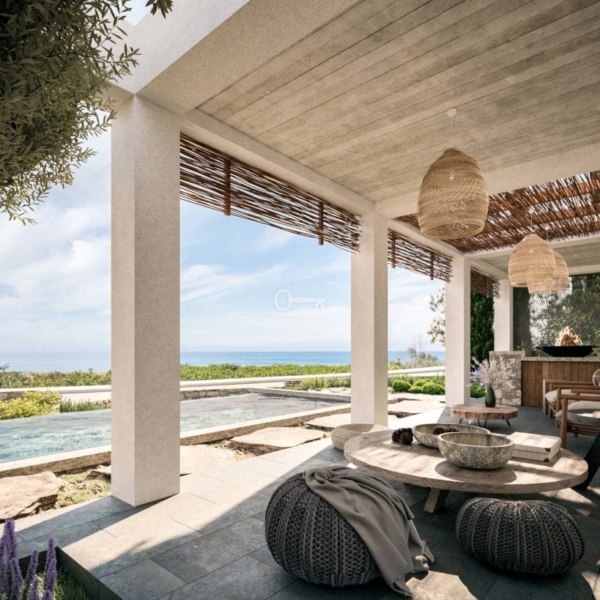
Cyprus is increasingly appearing on the radar of people looking for property abroad not only for holidays, but also as a second home and part of a long-term wealth strategy. Its climate, accessibility and tax system make it an attractive option for those planning to spend a significant part of the year on the island. However, buying a property involves much more than choosing an apartment with a sea view. Location, the purpose of the property, how it will be used, transaction costs and proper legal due diligence all matter.
Cyprus as a second home. Lifestyle matters, but the property must preserve and build its value
Cyprus has one quality that is difficult to overstate when it comes to a second home. There is no need to choose between a place to live and a market in which to allocate capital. A well-selected property can successfully combine both functions.
Mornings begin differently here than in Poland. A terrace, sunlight, the sea and the possibility of using the property for most of the year make Cyprus a natural destination for those looking for their own place in Southern Europe. From an investor’s perspective, however, what happens outside the holiday season is equally important. The property should be located somewhere that remains attractive even when some of the tourists have left the island.
This is precisely why, when buying a second home, it is better not to start by asking which apartment makes the strongest impression during the first visit. A better question is: how will this property function in five or ten years?
At Partners International, we take a similar approach to selecting international properties. The market is not a catalogue that needs to be browsed from the first page to the last. Its value lies in the ability to reject properties that do not match a specific purchasing objective and to focus on addresses that make sense both from a lifestyle perspective and in terms of long-term value.
Paphos, Limassol or Larnaca?
Choosing the island is only the beginning. In Cyprus, location is particularly important because different parts of the market respond to very different needs.
Paphos is strongly associated with the second-home market. This is also where the expert quoted in materials on the Cypriot property market lives. For years, she has been helping Polish clients purchase apartments and houses by the sea.
Limassol has a different character. It is a more urban, international and business-oriented market. For some buyers, this distinction will be decisive. The property is intended to be not only a place to spend a few weeks each year, but part of everyday life, with access to infrastructure and services.
Larnaca may appeal to those looking for a quieter pace while still wanting good transport connections. When buying a property as a second home, the distance from the airport matters more than it may seem during the first visit. If the journey takes too long, a spontaneous weekend in Cyprus quickly stops being spontaneous.
This is one of the reasons why a location should not be assessed solely through the view from the terrace. The view may be spectacular, but if the property is far from everyday infrastructure, the airport and the places the owner will actually use, its appeal may look very different after several months.
Apartment or villa?
In Cyprus, the choice between an apartment and a villa affects more than just the purchase price. It also determines how the property will be used and the range of responsibilities that will remain with the owner.
An apartment in a gated development may be a more convenient solution for someone who spends several weeks or months a year on the island. Security, common areas, a swimming pool or gardens may all be managed by the community or development management. The owner therefore does not need to organise the entire technical infrastructure every time they are away. In return, there are community fees and regulations governing the use of the property.
A villa offers greater privacy and freedom. A private swimming pool, garden and larger living space create completely different conditions for enjoying the property. On the other hand, they require regular maintenance. The pool needs servicing, the garden needs care and the installations need to be checked even when the owner is not there.
The choice should therefore follow the owner’s lifestyle. For one person, the ideal solution may be an apartment they can return to after several months away and immediately enjoy all the available amenities. For another, a larger villa with a private garden may be the very reason for making the purchase.
How much does it cost to buy property in Cyprus?
The price shown in the listing is not yet the full cost of the transaction. In Cyprus, the way VAT is calculated is particularly important, as the rules concerning the primary market changed in June 2026.
From 16 June 2026, the reduced VAT rate of 5% may apply to the first 130 m² of an apartment or house, provided that the value of that portion does not exceed EUR 350,000. The entire property may have a maximum area of 190 m² and its price may not exceed EUR 475,000. If the property exceeds the relevant thresholds, it may be subject to the 19% rate. For properties priced between EUR 350,000 and EUR 475,000, two VAT rates may apply: 5% to the first portion of the value and 19% to the remainder.
The difference is well illustrated by the example of a 140 m² villa priced at EUR 470,000. In this case, 5% VAT is charged on EUR 325,000, while 19% is charged on the remaining EUR 145,000. This results in VAT of EUR 16,250 and EUR 27,550 respectively.
The timing of the payment itself is also important. When purchasing a property from a developer, the first payment may initially be made with 19% VAT applied. Once approval for the reduced rate has been obtained, the excess VAT is then settled. The payment schedule is usually linked to the stages of construction and may extend from several months to several years.
The mechanism is different on the secondary market. If VAT was not charged on the purchase, a Transfer Fee applies. The rates are 3% for values up to EUR 85,000, 5% for the portion between EUR 85,001 and EUR 170,000, and 8% above EUR 170,000. At the same time, a 50% reduction applies, meaning the effective rates are 1.5%, 2.5% and 4% respectively.
As of 1 January 2026, Stamp Duty has been abolished in Cyprus.
A lawyer in Cyprus plays a different role from a notary in Poland
There is another important difference for Polish buyers. Cyprus does not follow the same transaction model as Poland. There are no notarial deeds and no equivalent of the division between preliminary and final agreements familiar from the Polish market. Sale and purchase agreements are prepared by lawyers.
This is why an independent lawyer is one of the most important participants in the transaction. Their role is not limited to preparing documents. They should also conduct due diligence on the property and the developer, analyse the legal status and ensure that the buyer’s interests are properly protected. A lawyer’s standard fee is approximately 1% of the transaction value.
The purchase process also involves KYC procedures, meaning verification of identity and the source of funds. The materials concerning the purchasing process indicate, among other things, the need to provide tax returns from the previous two or three years as well as documents confirming the source of financing.
After the agreement has been signed and the first instalment paid, the lawyer registers the agreement with the Land Registry. Cyprus operates under a legal system derived from the common law tradition, which means that property ownership records are maintained differently from Polish land and mortgage registers. Once construction has been completed, there is also the procedure for obtaining the Certificate of Final Approval, followed by the issuance of Title Deeds for the specific property.
These are precisely the kinds of elements that mean purchasing property abroad should be treated as a process rather than as a single buying decision.
Cyprus may also be attractive from a tax perspective
Investors often analyse Cyprus not only because of its property market. The possibility of obtaining tax residency and Non-Dom status is another important factor.
One route is the 183-day rule. A person who stays in Cyprus for at least 183 days in a calendar year may qualify as a tax resident. There is also a 60-day rule. In this case, the individual must spend at least 60 days in Cyprus during the tax year while also meeting additional requirements concerning stays in other countries, place of residence and professional activity or holding a director position in a Cypriot company. Non-Dom status may be granted for 17 years.
The tax system also provides for a 12.5% corporate income tax rate and exemptions from tax on dividends and bank and investment interest within the scope described in the source materials.
For individuals receiving rental income, an annual tax-free allowance of EUR 19,500 applies. Above this amount, tax rates increase from 20% to 35%, depending on the level of income.
Cyprus also does not impose an annual property tax. This tax was abolished in 2017. There is also no inheritance tax, gift tax or wealth tax.
This does not mean, however, that every property purchased in Cyprus automatically becomes a tax-efficient investment. Tax residency is a separate matter and requires an analysis of the buyer’s individual circumstances. The same applies to the taxation of rental income. In these areas, the appropriate solution is to work with an independent tax adviser rather than basing a decision solely on general information about the tax system.
Property in Cyprus should also be viewed outside the holiday season
This is one of the issues that can easily be overlooked when purchasing a second home. Cyprus seen during a holiday may look very different from the Cyprus in which the property is expected to function throughout the year.
A marina full of restaurants, a beach just a few minutes from the apartment and lively evenings are strong arguments during a holiday. They do not, however, answer the question of what the neighbourhood looks like in January, how far away the nearest shop, school, medical centre or airport is, or whether the property remains convenient when it has not been used for several months.
When buying a second home, it is also worth calculating in advance the costs of property management, maintenance of common areas, the swimming pool and garden, as well as any potential rental management. The price per square metre alone does not provide a complete picture of the property’s economics.
The same applies to potential rental returns. Assuming high profitability without taking seasonality, taxes, management costs and vacancy periods into account can lead to a completely different calculation from the one initially presented.
Selection matters more than the number of listings
Cyprus is a market where it is easy to find a property that makes a strong first impression. It is much more difficult to find one that simultaneously matches the owner’s lifestyle, intended use, budget, rental expectations and long-term capital strategy.
This is where the role of an adviser begins.
At Partners International, the goal is not to show the client the entire market. The value lies in selection. First, the location and character of the property are analysed, followed by the standard of the project, intended use, costs and the potential of the address. Only then is a specific property presented to the client.
When purchasing abroad, access to trusted local specialists is equally important. A lawyer conducting due diligence, a tax adviser or a company managing the property after the purchase are all part of a process that cannot be seen in photographs of an apartment, but which largely determines the owner’s comfort and peace of mind.
Cyprus can therefore be an excellent destination for a second home. Not because every property on the island is a good investment. Quite the opposite. The larger and more diverse the market, the more important careful selection becomes.
For one client, the right choice may be a seaside apartment used for several weeks a year. For another, it may be a larger residence that allows them to spend several months on the island while also generating rental income. Another buyer may view Cyprus primarily through the lens of tax residency and long-term capital allocation.
A good property therefore does not begin with an address. It begins with answering the question of why you actually want to own it.


 87 m²
87 m²  4 / 4
4 / 4  2
2  3
3  2030
2030 


 468 m²